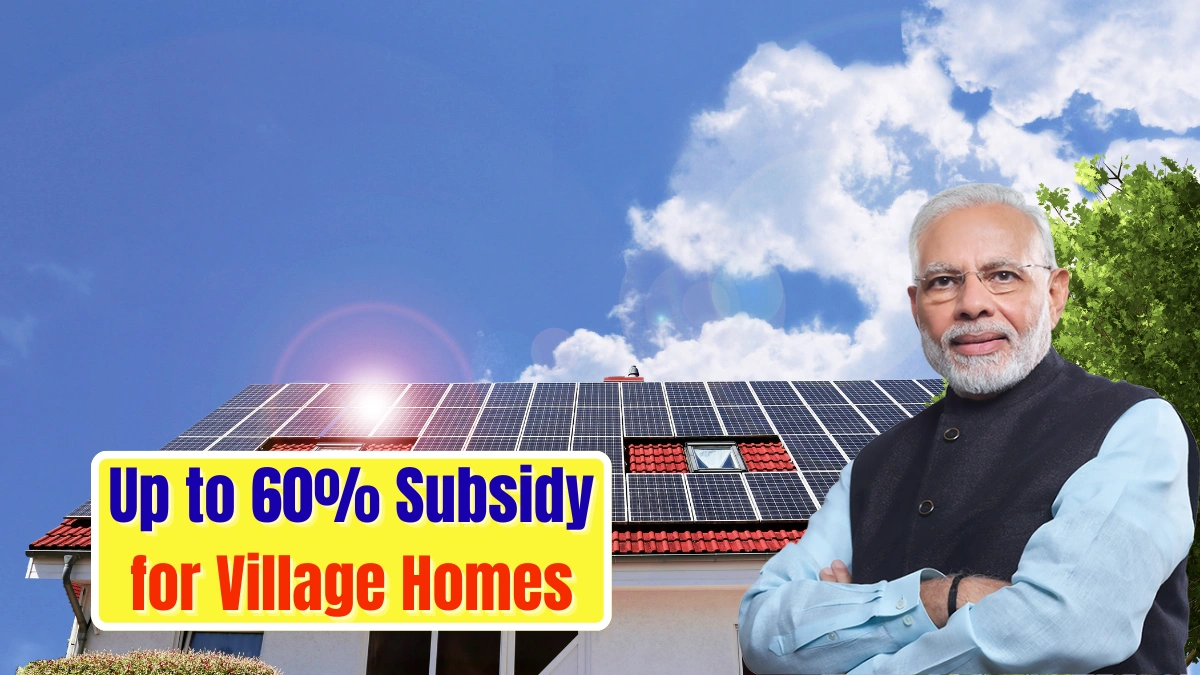
The government has launched the Solar Rooftop Yojana 2025 to make clean and affordable electricity easily accessible in rural India. Under this scheme, homeowners in villages who install rooftop solar panels can receive up to 60% subsidy, significantly reducing their installation cost. As electricity demand rises and power supply remains inconsistent in many regions, this scheme aims to make rural households energy-independent while cutting their monthly electricity bills.
What Is the Solar Rooftop Yojana 2025?
The Solar Rooftop Yojana 2025 is a government-backed initiative designed to promote solar panel installation in both urban and rural homes. However, the scheme places special focus on villages, where reliable electricity supply is still a challenge. By offering a high subsidy, the government wants to encourage more rural families to install rooftop solar systems and generate their own power at minimal cost.
How Much Subsidy Can You Get?
The subsidy structure of this scheme is designed to benefit small and medium rural households.
Under the 2025 policy:
For the first 2 kW, the government provides 60% subsidy.
For 2 kW to 3 kW, the subsidy reduces to around 40%.
For systems above 3 kW, no additional central subsidy is offered.
This makes rooftop solar extremely affordable for most village homes, especially those looking to reduce rising electricity bills.

Who Is Eligible for This Scheme?
All residential households with a valid electricity connection can apply for this scheme. Applicants must have adequate rooftop space, a verified Aadhaar card, and a bank account for direct subsidy transfer. The rooftop solar system must be installed by an empanelled vendor approved by the state DISCOM or the national solar portal. Even tenants with a valid NOC from the house owner can apply.
How to Apply for Solar Rooftop Yojana 2025
The application process is completely online and simple to follow.
First, visit your state’s DISCOM website or the national rooftop solar portal and register using your electricity consumer number.
Select the required solar capacity and submit your application for feasibility approval.
Once approved, an empanelled vendor installs the system and completes the net-metering process.
After verification, the subsidy amount is credited directly to your bank account.
This transparent system ensures safe and timely subsidy distribution to rural households.
Documents Required for Application
To apply, you need a valid Aadhaar card, the latest electricity bill, bank passbook details, address proof, and a passport-size photograph. Some states may ask for additional documents depending on regional policy requirements. Keeping documents ready will help speed up approval and installation.

Benefits of Solar Panels in Rural Areas
Rooftop solar panels provide long-term power savings for up to 25 years.
Rural homes facing frequent power cuts benefit from consistent electricity supply.
Electricity bills reduce significantly, often reaching near-zero.
Solar power supports agricultural use, small businesses, and household appliances without relying on grid supply.
It also helps reduce pollution and promotes clean energy consumption.
Why the Scheme Matters for Village Households
A large number of villages still struggle with irregular electricity supply, affecting daily life and productivity. Solar Rooftop Yojana 2025 offers an affordable solution by allowing households to produce their own energy. The high subsidy of up to 60% reduces installation costs dramatically, making solar energy accessible to even low-income rural families. This initiative also creates local employment through installation and maintenance work.
Conclusion: Solar Rooftop Yojana 2025 is a major opportunity for rural India to adopt clean, cost-effective, and reliable solar energy. With up to 60% subsidy, families can install solar panels at a fraction of the cost and enjoy long-term savings on their electricity bills. Homeowners in villages should take advantage of this scheme and apply early to ensure timely installation and maximum benefits.

Disclaimer: Information provided in this article is based on available government guidelines. Subsidy percentages and procedures may vary by state. Applicants are advised to verify details through their local DISCOM or the official solar portal before applying.