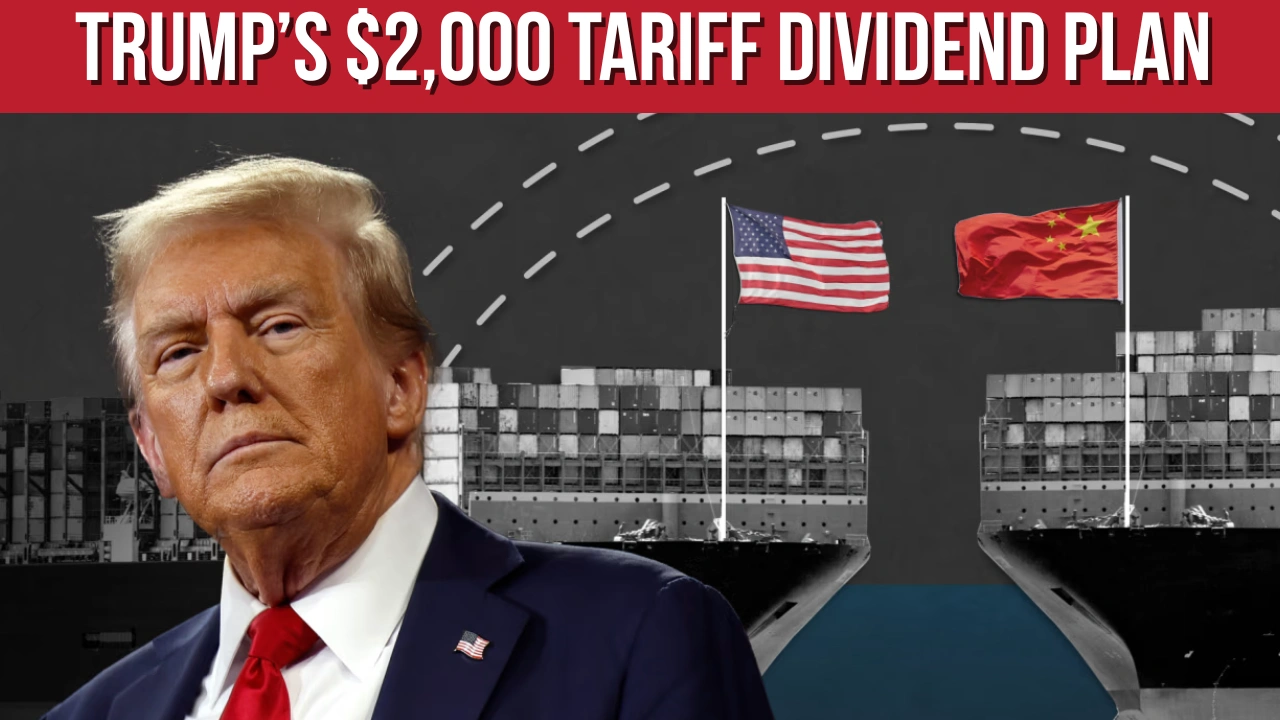
Trump’s $2,000 Tariff Dividend Plan: Former U.S. President Donald Trump has unveiled a new proposal that he says would deliver a “$2,000 tariff dividend” to every American household if he returns to the White House. The plan — one of his most headline-grabbing economic promises — ties directly to his proposal for sweeping tariffs on imports, which he argues would generate enough government revenue to fund direct payments to U.S. citizens.
While Trump calls it “a bold new approach to put America first and the American people first,” economists and trade experts are sharply divided over its feasibility and long-term impact. Here’s a detailed look at what the proposal means, how it would work, and the controversies surrounding it.
What the “Tariff Dividend” Plan Is
Trump’s $2,000 Tariff Dividend Plan- Trump’s $2,000 tariff dividend plan is built on the idea that the U.S. government would collect massive new revenue by imposing tariffs on imported goods — particularly from countries like China, Mexico, and Vietnam — and then redistribute a portion of that money directly to American citizens.
According to Trump’s campaign team, the plan would involve:
- A universal $2,000 annual payment to every U.S. household.
- Funded entirely by tariff revenue from imported goods.
- Aimed at “offsetting” the cost of higher prices that tariffs might cause on consumer products.
Trump has described it as “a patriotic dividend”, claiming it would make foreign exporters — not American taxpayers — pay for the program.

How It Would Work
Under Trump’s proposed “universal baseline tariff”, nearly all imports to the U.S. would face a 10% levy, while Chinese goods could face tariffs of up to 60% or higher. His campaign argues that these tariffs could raise hundreds of billions of dollars annually, part of which would be redistributed to U.S. families as cash payments.
Trump advisers have compared it to a “reverse tax credit,” where every American receives a fixed amount each year. The payments, they say, would “restore wealth to American workers” who’ve lost out due to decades of globalization and offshoring.
The Economic Math — and Skepticism
Economists are skeptical that such a plan could actually fund itself. Tariffs are effectively taxes on imports, and while they do raise revenue, they also increase costs for consumers and slow trade.
Experts from the Tax Foundation and Peterson Institute for International Economics estimate that Trump’s tariffs could cost the average U.S. household between $1,200 and $1,500 annually in higher prices — meaning much of the “dividend” could be offset by inflation.
“It’s a circular system — Americans pay more for goods, the government collects that money, and then gives some of it back,” said Dr. Laura Bennett, senior trade economist at Columbia University. “It’s politically clever, but economically inefficient.”
Still, Trump’s campaign claims the overall impact would be “strongly positive”, as the tariffs would revitalize U.S. manufacturing, create jobs, and reduce reliance on China.
The Political Strategy
Trump’s $2,000 tariff dividend plan comes at a time when cost of living, inflation, and global trade tensions are among the top concerns for American voters.
By framing the proposal as “a dividend for every American,” Trump aims to position himself as a populist economic reformer, similar to his 2016 campaign promise to bring jobs back from overseas.
Republicans have largely praised the idea as “pro-worker and pro-America”, while Democrats argue it could destabilize global trade and hurt U.S. exporters.
Impact on Global Trade
If implemented, Trump’s tariff plan would mark one of the largest trade policy shifts in modern history.

- It could reignite trade tensions with China, leading to retaliatory tariffs on U.S. exports.
- It might trigger price surges in everyday products like electronics, cars, and groceries.
- Allies in Europe and Asia could challenge the move at the World Trade Organization (WTO), arguing it violates global trade rules.
The International Monetary Fund (IMF) has warned that widespread tariff increases could shrink global GDP by 1–2%, potentially sparking new trade wars.
What It Means for Americans
If the plan worked as Trump envisions, every U.S. household could receive an annual $2,000 check — a politically powerful promise that might appeal to middle- and lower-income voters.
However, consumers would likely pay more upfront for imported goods, meaning the net benefit could vary widely depending on income, consumption habits, and inflation trends.
Economists say the plan’s success would depend on whether domestic production could scale fast enough to replace imports — a challenge that would take years, not months.
Conclusion: Trump’s proposed $2,000 tariff dividend is a bold, unconventional idea that combines populist politics with protectionist economics. It taps into public frustration over inflation, foreign trade, and stagnant wages — but it also raises difficult questions about cost, feasibility, and long-term impact.

While it may energize voters ahead of the next election, experts agree that the real-world effects of such a policy would depend heavily on global trade reactions, consumer behavior, and how much of the burden truly falls on foreign exporters — rather than American households.
Disclaimer: This article is for informational purposes only. The details and analysis presented are based on available campaign statements, expert opinions, and public economic data as of November 2025. Readers should follow verified outlets such as Reuters, Bloomberg, and U.S. Department of Commerce releases for updates on trade and fiscal policies.